
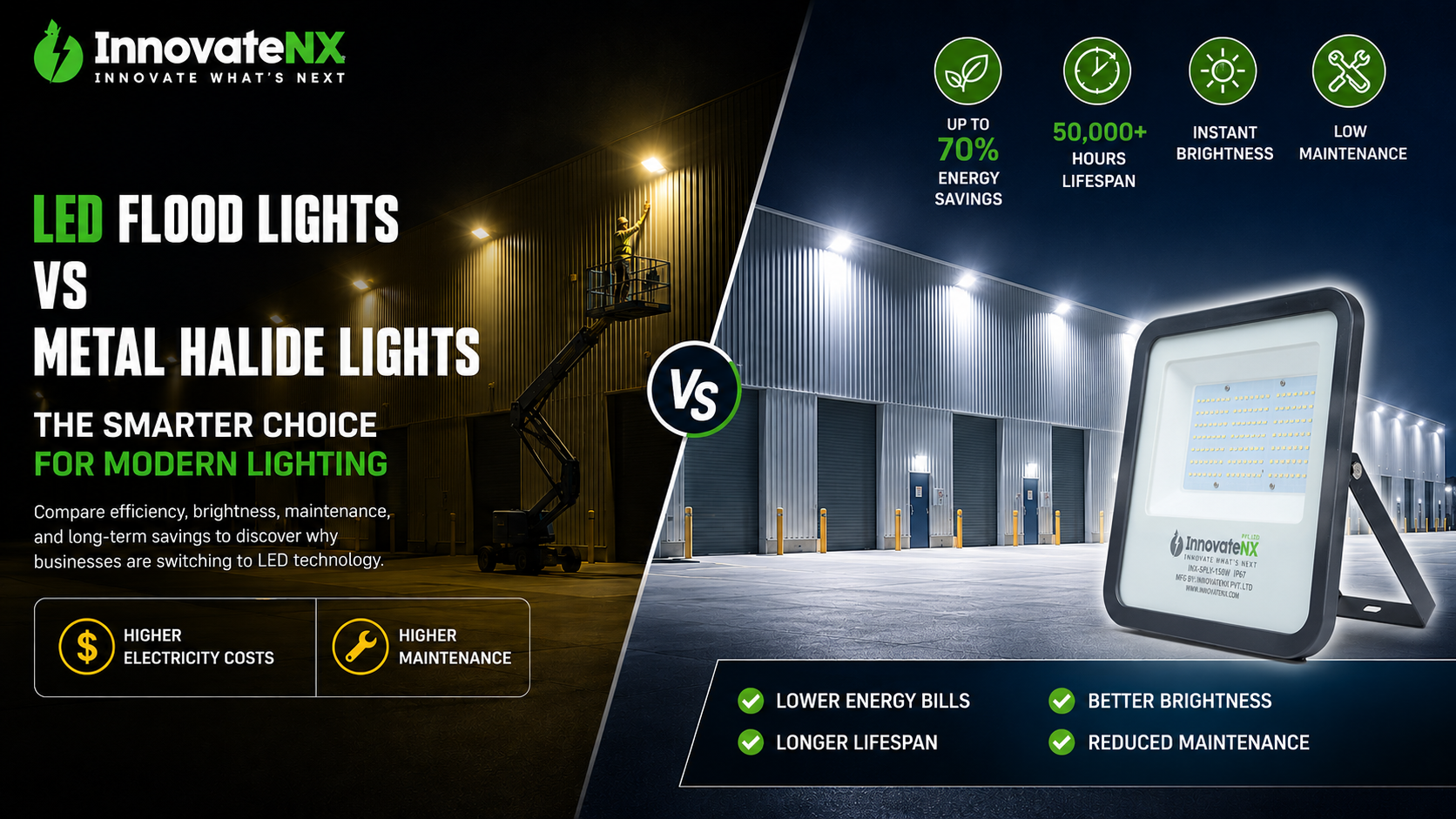
LED Flood Lights vs Traditional Metal Halide Lights: Which Is Better?
Lighting affects safety, productivity, and operating costs.
It also impacts maintenance expenses and energy consumption.
For many years, metal halide lights were the preferred choice for factories, warehouses, stadiums, and outdoor spaces.
However, lighting technology has changed.
Today, LED flood lights are replacing traditional metal halide systems across industries.
Businesses are making the switch because they want lower costs, better performance, and improved efficiency.
But which option is truly better?
This guide compares LED flood lights and traditional metal halide lights to help you make the right decision.
What Are LED Flood Lights?
LED flood lights use Light Emitting Diode technology.
They produce bright and focused illumination while using less electricity.
LED flood lights are commonly installed in:
- Warehouses
- Manufacturing plants
- Parking areas
- Stadiums
- Commercial buildings
- Outdoor spaces
- Public infrastructure
Modern LED flood lights are designed to provide high brightness, long life, and reliable performance.
InnovateNX offers advanced LED flood lighting solutions that help businesses reduce energy costs while improving visibility.
What Are Metal Halide Lights?
Metal halide lights are a type of High-Intensity Discharge (HID) lighting.
They generate light through an electric arc inside a gas-filled lamp.
For decades, these lights were widely used in large outdoor and industrial applications.
Common uses include:
- Sports facilities
- Airports
- Industrial sites
- High mast lighting
- Parking lots
- Large commercial areas
Although metal halide lights provide strong illumination, they have several limitations when compared with modern LED technology.
Energy Efficiency Comparison
Energy efficiency is one of the biggest reasons businesses upgrade their lighting systems.
Metal halide lights consume a large amount of electricity.
A typical metal halide fixture may use between 250 watts and 1000 watts.
LED flood lights can often produce the same brightness while consuming much less power.
This reduction in energy use directly lowers electricity bills.
For facilities that operate lighting for many hours each day, the savings can be significant.
Lower energy consumption also helps reduce environmental impact.
Winner: LED Flood Lights
LED technology provides better efficiency and lower operating costs.
Brightness and Light Quality
Brightness is important.
However, light quality matters just as much.
Metal halide lights often lose brightness over time.
As the lamp ages, the light output gradually decreases.
This creates uneven lighting conditions.
LED flood lights maintain consistent brightness throughout most of their lifespan.
They also provide:
- Better visibility
- Uniform illumination
- Improved color rendering
- Reduced shadows
- Enhanced safety
Good lighting helps employees work more effectively and improves overall site security.
Winner: LED Flood Lights
LED lighting delivers more consistent and higher-quality illumination.
Lifespan Comparison
Lighting lifespan affects maintenance budgets and replacement schedules.
Metal halide lamps typically last between 10,000 and 20,000 hours.
LED flood lights can operate for 50,000 hours or more.
This means LED fixtures can last several times longer than metal halide systems.
Fewer replacements mean lower maintenance costs.
Longer lifespan also reduces downtime and operational interruptions.
Businesses can focus on productivity instead of frequent lighting maintenance.
Winner: LED Flood Lights
Long service life makes LED technology a smarter long-term investment.
Maintenance Requirements
Maintenance costs can become expensive over time.
Metal halide lighting systems require:
- Lamp replacements
- Ballast repairs
- Routine inspections
- Additional labor
These maintenance activities increase operating expenses.
LED flood lights require very little maintenance.
Their solid-state design improves durability and reliability.
This is especially important in facilities where lights are installed at significant heights.
Reducing maintenance needs saves both time and money.
Winner: LED Flood Lights
Lower maintenance requirements reduce long-term costs.
Startup and Restart Performance
Metal halide lights require warm-up time.
After switching on, they may take several minutes to reach full brightness.
If power is interrupted, they often need additional time before restarting.
This can create operational challenges.
LED flood lights operate differently.
They provide full brightness immediately.
There is no warm-up delay.
Instant illumination improves convenience, safety, and reliability.
Winner: LED Flood Lights
Immediate startup provides a major performance advantage.
Heat Generation
Heat affects efficiency and operating conditions.
Metal halide lights produce a large amount of heat during operation.
This wasted energy can increase cooling requirements in indoor facilities.
LED flood lights generate much less heat.
They convert more electricity into usable light.
This improves overall efficiency and reduces energy waste.
Lower heat output also helps create a more comfortable environment for workers.
Winner: LED Flood Lights
LED systems offer better thermal performance.
Environmental Impact
Sustainability is becoming increasingly important.
Many organizations are working to reduce their environmental footprint.
Metal halide lamps require special handling and disposal procedures.
Their shorter lifespan also creates more waste over time.
LED flood lights provide a cleaner solution.
They use less electricity and last longer.
This helps reduce carbon emissions and waste generation.
Many businesses choose LED technology as part of their sustainability strategy.
Winner: LED Flood Lights
LED lighting supports environmentally responsible operations.
Cost Comparison
Metal halide fixtures often have a lower initial purchase price.
However, purchase cost is only one part of the equation.
Businesses should also consider:
- Energy expenses
- Maintenance costs
- Replacement frequency
- Operating efficiency
When these factors are included, LED flood lights often provide a much lower total cost of ownership.
The higher upfront investment is usually recovered through long-term savings.
Winner: LED Flood Lights
LED technology provides better financial value over time.
Where LED Flood Lights Perform Best
LED flood lights are suitable for many applications.
These include:
- Warehouses
- Factories
- Sports complexes
- Airports
- Parking facilities
- Commercial properties
- Industrial sites
- Security lighting systems
InnovateNX LED floodlights are designed to deliver dependable performance in demanding environments.
Why Businesses Choose InnovateNX LED Flood Lights
Businesses need lighting solutions that combine efficiency, durability, and performance.
InnovateNX develops advanced LED flood lighting systems for industrial and commercial applications.
Key advantages include:
- High energy efficiency
- Long operational life
- Excellent illumination quality
- Reduced maintenance costs
- Reliable outdoor performance
- Sustainable lighting solutions
These benefits help organizations improve productivity while reducing operating expenses.
Conclusion
The comparison between LED flood lights and traditional metal halide lights is clear.
LED flood lights perform better in nearly every category.
They consume less electricity.
They last longer.
They require less maintenance.
They provide better light quality.
They also support sustainability goals and lower operating costs.
While metal halide lighting served industries for many years, modern LED technology offers a more efficient solution.
For businesses looking to improve lighting performance and reduce expenses, LED flood lights are the smarter choice.
InnovateNX continues to provide advanced LED lighting solutions that help organizations build safer, brighter, and more energy-efficient facilities.
📅 Last updated:
