
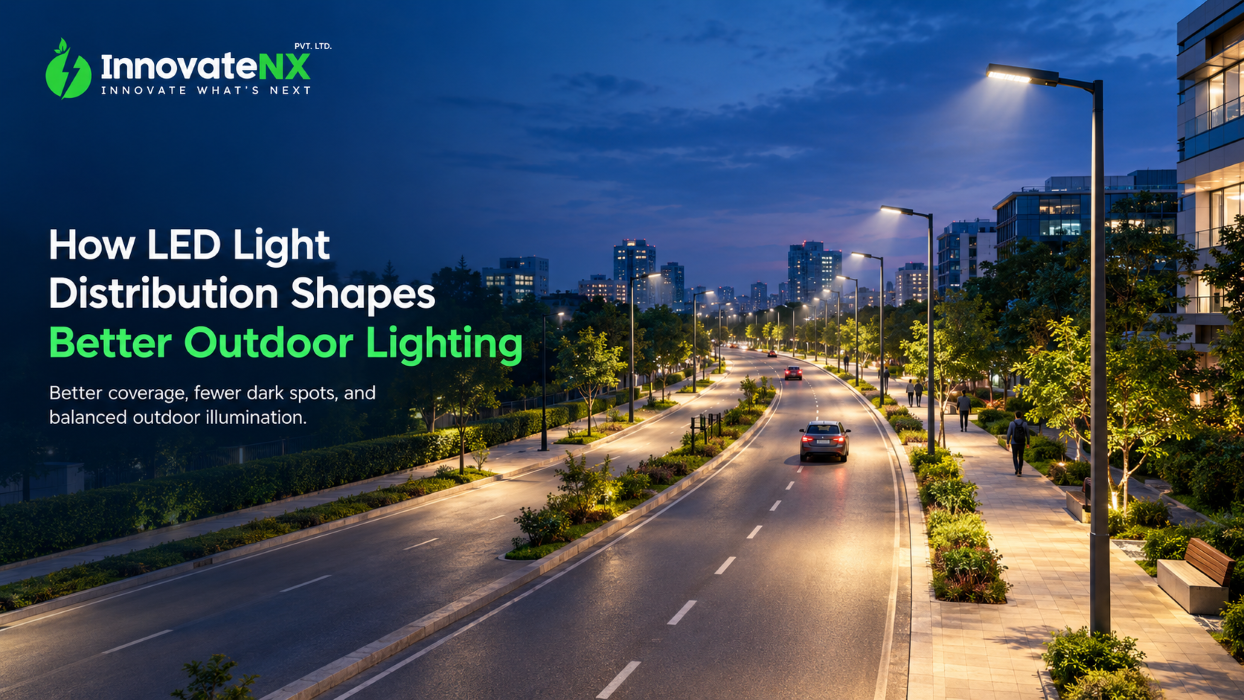
How LED Light Distribution Shapes Better Outdoor Lighting Design
Good outdoor lighting is not only about brightness.
The way light spreads also matters.
A powerful LED light can still create dark areas. It can also create unwanted glare if the light is poorly distributed.
That is why LED light distribution is an important part of modern lighting design.
It controls where the light goes. It also affects how evenly an area is illuminated.
For roads, pathways, parking areas, campuses, and large outdoor spaces, proper light distribution can improve the entire lighting experience.
What Is LED Light Distribution?
LED light distribution describes how a fixture spreads light across an area.
Some fixtures send light over a wide area.
Others focus light into a narrower zone.
The right option depends on the application.
For example, a narrow road may need controlled light along its length. A parking area may need wider coverage.
A sports ground may need focused lighting toward the playing area.
Therefore, one distribution pattern does not suit every project.
Why Light Distribution Matters
Light distribution affects more than brightness.
It can influence:
- Visibility
- Coverage
- Uniformity
- Glare
- Dark spots
- Energy use
- Visual comfort
- Overall lighting quality
A good lighting design places light where it is needed.
It avoids wasting light in unwanted areas.
This can create a cleaner and more efficient lighting layout.
Brightness Alone Is Not Enough
It is easy to assume that brighter means better.
That is not always true.
Too much light in one area can create glare. At the same time, another area may remain poorly lit.
This creates an uneven lighting environment.
Good outdoor lighting aims for balance.
The light should reach the required surface. It should also maintain suitable uniformity.
This is why fixture selection should consider distribution, not only wattage.
Understanding LED Beam Angles
Beam angle describes how widely light spreads from a fixture.
A narrow beam concentrates light into a smaller area.
A wide beam spreads light across a larger area.
Both options have useful applications.
Narrow Beam
A narrow beam can work well when light needs to reach a specific target.
It can be useful for focused applications and certain large-area installations.
Medium Beam
A medium beam offers a balance between reach and coverage.
It can work well for many outdoor applications.
Wide Beam
A wide beam spreads light over a broader area.
It works well for open spaces, pathways, parking areas, and similar applications.
The right beam angle depends on the mounting height, target area, and required coverage.
The Role of Light Uniformity
Uniformity means how evenly light is distributed across a surface.
Good uniformity reduces large differences between bright and dark areas.
This is important for outdoor environments.
Road users need consistent visibility.
Pedestrians need comfortable pathways.
Workers need clear visibility around outdoor work areas.
Uneven lighting can make some areas appear too bright while others appear too dark.
A well-planned lighting layout can help reduce this problem.
Avoiding Dark Spots
Dark spots often appear when fixtures are placed too far apart.
They can also occur when the beam pattern does not match the installation.
The result is uneven coverage.
This is why spacing should be planned with the fixture’s distribution pattern.
The mounting height also matters.
A fixture installed higher can cover a larger area. However, the light may also become less concentrated on the target surface.
The solution is to balance fixture height, spacing, and distribution.
Controlling Glare
Glare occurs when light is too bright or enters the viewer’s eyes at an uncomfortable angle.
Outdoor lighting should provide useful illumination without unnecessary visual discomfort.
Proper aiming can help control glare.
The fixture should direct light toward the required area.
It should not point directly toward drivers, pedestrians, or nearby buildings.
Good fixture positioning is therefore an important part of outdoor lighting design.
Matching Distribution to the Application
Different outdoor areas have different lighting needs.
Roads
Road lighting needs controlled distribution along the driving surface.
The light should cover the road without creating excessive glare.
Parking Areas
Parking areas usually need broader coverage.
The goal is to illuminate driving lanes, parking spaces, and pedestrian areas.
Pathways
Pathways need comfortable and consistent lighting.
A suitable distribution pattern can help improve visibility along walking routes.
Commercial Spaces
Commercial properties often need both functional and attractive lighting.
The lighting should cover important areas while supporting the appearance of the property.
Large Outdoor Areas
Open spaces need careful planning.
The fixture arrangement should match the area’s size and shape.
This helps reduce unnecessary overlap and dark zones.
How InnovateNX Approaches Outdoor Lighting
InnovateNX provides lighting solutions for different outdoor applications.
Choosing the right fixture is only one part of a successful lighting project.
The fixture must also be installed correctly.
Its position, height, spacing, and aiming direction all affect the final result.
This makes lighting design an important part of the overall project.
The right combination can help create useful and balanced illumination.
Light Distribution and Energy Efficiency
Good distribution can also support efficient lighting design.
The goal is to put light where it is required.
Poor distribution can send light into areas that do not need it.
This can reduce the effectiveness of the lighting system.
A well-planned layout can help make better use of each fixture.
It may also reduce the need for unnecessary additional fixtures.
However, energy performance depends on the complete lighting system.
Fixture efficiency, operating hours, controls, spacing, and design all matter.
Choosing the Right LED Fixture
Before selecting an outdoor LED fixture, review the application.
Ask a few simple questions:
- What area needs illumination?
- How high will the fixture be installed?
- How wide is the target area?
- How much uniformity is required?
- Where could glare become a problem?
- What beam distribution is suitable?
- How far apart should fixtures be placed?
These questions help create a more effective lighting plan.
The answer should come from the application rather than wattage alone.
Why Professional Lighting Design Matters
A lighting project can look simple.
However, many factors influence the final result.
A professional approach considers the fixture, mounting height, spacing, beam angle, surface area, and lighting requirements together.
This helps create a balanced system.
It also reduces the risk of bright spots and dark zones.
InnovateNX lighting solutions can be selected according to the specific requirements of different outdoor projects.
The right product and the right layout should always work together.
Final Thoughts
LED lighting has changed how outdoor spaces are illuminated.
However, choosing an LED fixture is only the beginning.
Light distribution determines where that illumination goes.
Beam angle affects coverage.
Uniformity affects visual consistency.
Aiming affects glare.
Spacing affects the overall lighting pattern.
Therefore, modern outdoor lighting should focus on more than brightness.
It should focus on where the light goes and how evenly it covers the required area.
Whether the project involves roads, pathways, parking areas, commercial spaces, or large outdoor zones, the lighting design should match the application.
InnovateNX offers lighting solutions to meet different outdoor needs.
With the right fixture, distribution pattern, mounting position, and spacing, outdoor spaces can achieve better visibility and more balanced illumination.
The best lighting design isn’t simply the brightest.
It is the one that puts the right amount of light in the right place.
📅 Last updated:
