
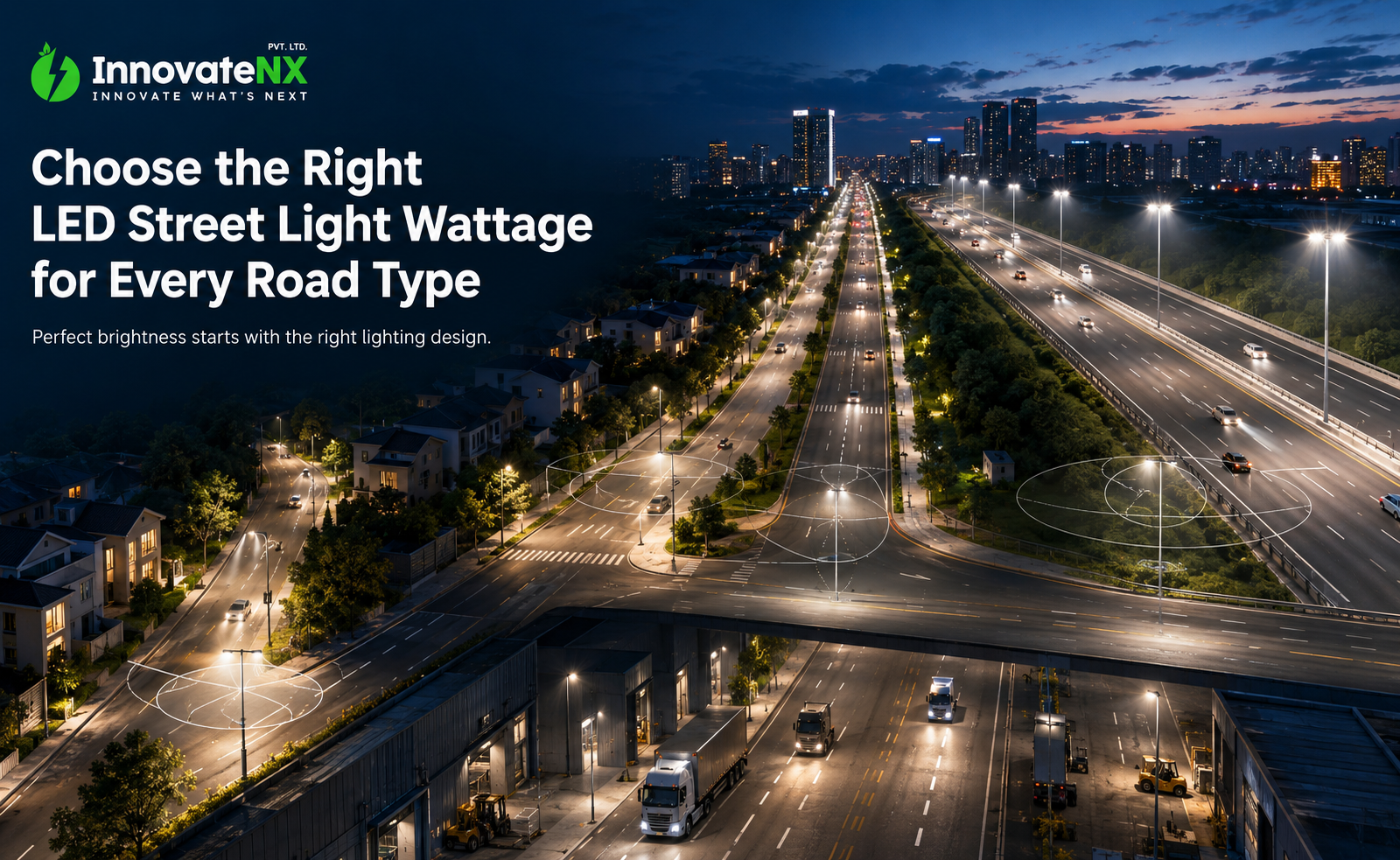
Choosing the right LED street light wattage is essential for safe, efficient, and cost-effective outdoor lighting. A light that is too weak can create dark zones and safety risks. A light that is too powerful can waste energy, increase glare, and raise project costs.
Every road has different lighting needs. A narrow residential lane does not need the same output as a busy highway. Similarly, a park pathway needs softer illumination than an industrial access road.
This guide explains how to choose the right LED street light wattage for different road types. It also helps planners, contractors, developers, and municipalities make better lighting decisions.
Why LED Street Light Wattage Matters
Wattage shows how much electrical power a light consumes. However, wattage alone does not define lighting quality. You must also check lumen output, beam angle, pole height, road width, and installation spacing.
Modern LED lights produce more brightness while using less energy. Therefore, an LED street light can replace a much higher-wattage traditional light. For example, a 50W LED street light can often deliver useful brightness for smaller roads and pathways.
The correct LED street light wattage improves visibility. It also reduces energy use and maintenance requirements. Consequently, the lighting system performs better for years.
Key Factors Before Selecting Street Light Wattage
Before choosing a product, review the site conditions. This step prevents under-lighting and over-lighting.
Road Width
Wide roads need wider light coverage. They may also need higher wattage fixtures or more poles. Narrow roads need lower output and closer control.
Pole Height
Higher poles need stronger lights. A 4-meter pole needs less wattage than an 8-meter pole. The light must travel farther from a taller pole to reach the road surface.
Pole Spacing
The distance between poles affects brightness uniformity. If poles are far apart, higher wattage may be required. If poles are close, lower wattage can work well.
Traffic Volume
Roads with heavy traffic need better visibility. High-speed vehicles need clear road edges, signs, turns, and obstacles. Low-traffic lanes need balanced illumination without harsh glare.
Surrounding Environment
A busy market road has more ambient light than a rural road. Dark rural roads may need higher brightness. Residential zones may need controlled lighting to avoid disturbing nearby homes.
Best LED Street Light Wattage for Residential Streets
Residential streets usually have low traffic speed and moderate pedestrian movement. These roads need comfortable, uniform light. The goal is safety without excessive brightness.
For narrow residential roads, a 30W to 50W LED street light is often suitable. This range works well for roads with lower poles and short spacing.
For wider colony roads or internal township roads, a 50W to 60W LED street light can provide better coverage. It supports clear visibility near gates, turns, parking areas, and pedestrian crossings.
Choose a warm white or neutral white colour temperature for residential areas. It creates a more comfortable environment than harsh blue-white light.
Best Wattage for Village Roads and Rural Lanes
Village roads and rural lanes often have very little ambient light. They may also have uneven surfaces, open land, trees, and sharp turns. Good lighting can improve safety for pedestrians, cyclists, and vehicles.
A 40W to 60W LED street light is suitable for most village roads. It provides useful visibility without creating unnecessary energy costs.
For wider rural roads, bus routes, or junctions, consider a 60W to 80W LED street light. These lights can improve road recognition from a distance.
Solar lighting is also a practical choice for remote locations. InnovateNX semi-integrated and integrated solar street lighting solutions can support roads where grid power is limited or expensive to extend.
Best Wattage for City Roads and Main Streets
City roads carry more traffic, pedestrians, two-wheelers, cars, and commercial activity. These roads need higher illumination and better uniformity.
For standard urban roads, a 60W to 100W LED street light is usually a strong choice. The exact wattage depends on pole height, road width, and pole spacing.
A 60W or 80W model may suit two-lane roads with moderate traffic. A 100W model may be better for wider roads, intersections, service roads, and busy commercial zones.
Use fixtures with strong optical design. Proper lenses direct light toward the road surface. This reduces wasted light and improves visual comfort.
Best Wattage for Highways and Expressways
Highways need powerful and reliable lighting. Vehicles move at high speed. Drivers must see lane markings, road signs, curves, merging points, and hazards clearly.
For highways, use 120W to 200W LED street lights. Large junctions, toll plazas, flyovers, and wide highway sections may require higher output or multiple fixtures.
Pole height is important on highways. Taller poles need stronger lights and accurate beam distribution. A professional lighting layout should be prepared before installation.
Do not select highway lighting only by wattage. Check lumen output, beam angle, glare control, surge protection, and IP rating. These details directly affect performance and service life.
Best Wattage for Industrial Roads and Factory Areas
Industrial roads require bright and dependable lighting. Trucks, forklifts, workers, and loading vehicles often operate during early mornings or late nights.
For internal factory roads, a 80W to 120W LED street light is usually effective. For loading zones, storage yards, and truck movement areas, use 100W to 150W LED lights.
Industrial sites may also need LED flood lights for wide open areas. InnovateNX offers flood lighting solutions that can support warehouses, yards, building exteriors, and industrial work zones.
Choose lights with durable housings, strong heat management, and weather-resistant protection. These features help the system handle dust, rain, heat, and long operating hours.
Best Wattage for Parks, Walkways, and Campus Roads
Parks and pedestrian paths need soft but clear lighting. Too much brightness can create glare and reduce the peaceful feel of the space.
For walkways, garden paths, and small campus roads, use 20W to 40W LED street lights. These lights provide enough visibility for walking, cycling, and security patrols.
For wider campus roads, parking zones, and entry roads, choose 40W to 60W LED street lights. The goal is even illumination with minimal dark spots.
Solar street lights are useful for parks and landscaped areas. They reduce cable work and support cleaner outdoor infrastructure.
Choose Quality Along With Wattage
The right wattage is only one part of the decision. Always check the full product specification before purchasing.
Look for these important features:
- High lumen efficiency for better brightness per watt
- Suitable beam angle for road width and pole height
- IP-rated housing for dust and water protection
- Surge protection for voltage fluctuations
- Strong heat dissipation for longer LED life
- Durable body material for outdoor use
- Reliable driver quality for stable operation
- Proper mounting support for easy installation
InnovateNX provides outdoor LED lighting solutions for streets, industrial zones, commercial spaces, campuses, and public infrastructure. A suitable lighting plan can help you choose the right fixture, wattage, pole height, and spacing for your site.
Final Thoughts
Selecting the right LED street light wattage improves road safety, energy efficiency, and long-term project value. Small lanes may need 30W to 50W lights. City roads may need 60W to 100W models. Highways and industrial areas may require 120W or more.
Always study the road type, pole height, spacing, traffic level, and surrounding conditions. This approach helps you avoid costly lighting mistakes.
📅 Last updated:
