
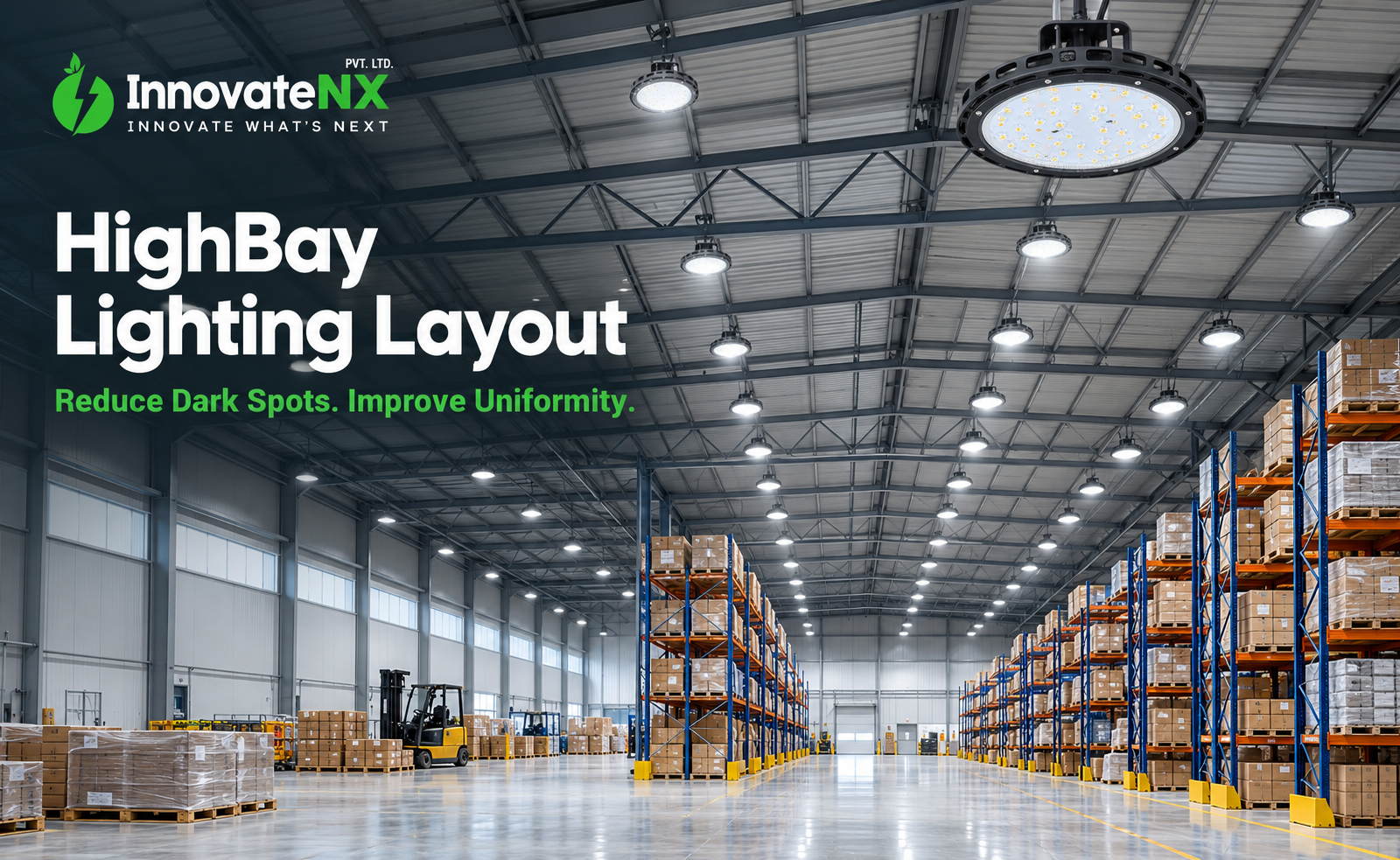
Good lighting helps people work safely and comfortably in warehouses, factories, and other large indoor spaces. However, installing powerful lights does not always guarantee even illumination. Poor placement can leave dark areas, create glare, or waste light where it is not needed.
InnovateNX HighBay lights suit industrial spaces with high ceilings. To get the best result from any HighBay fixture, plan the complete lighting layout before installation. Mounting height, beam angle, spacing, and the work being done all affect the final result.
What Is HighBay Lighting?
HighBay lighting is designed for spaces with high ceilings, such as warehouses, manufacturing units, workshops, and distribution centres. These fixtures direct light from above onto floors, workstations, storage racks, and production areas.
A suitable HighBay lighting system helps workers see equipment, labels, pathways, and materials more clearly. The right design also helps avoid unnecessary bright spots and shadowed areas.
The best fixture depends on the ceiling height, room dimensions, required light levels, and the type of work performed in the space.
Why Do Dark Spots Appear?
Dark spots usually occur when lights are too far apart, their beam angles do not suit the room, or objects block the light. A layout based only on the number of fixtures may miss these issues.
Tall storage racks can cast shadows across aisles. Machines and overhead structures can block light from reaching work surfaces. A narrow beam may create bright circles with darker gaps between them.
To prevent these problems, assess the room before selecting fixture positions. Consider shelves, machinery, workstations, walkways, and other obstacles that may affect light distribution.
Plan the Layout Before Installation
Start by measuring the room’s length, width, and ceiling height. Mark the main work areas, storage racks, production lines, and walking routes on a simple floor plan.
Next, identify each area’s lighting needs. Detailed inspection tasks may need more light than general storage aisles. Loading zones may need consistent visibility for people and moving equipment.
Use the fixture’s verified photometric data to estimate light levels and uniformity. For larger facilities, a professional lighting calculation can help identify gaps before installation begins.
Choose the Right Mounting Height
Mounting height affects how light spreads across the floor. A higher fixture covers a wider area, but less light may reach a specific surface. A lower fixture may create stronger light directly underneath, with a smaller coverage area.
Choose a HighBay fixture suited to the actual ceiling height. Do not rely on wattage alone. Review lumen output, beam distribution, and the recommended installation range in the product specifications.
Also consider the height of shelves and equipment. The light must reach the working plane, not just the open floor.
Understand Beam Angles
Beam angle describes how widely a fixture spreads its light. A wide beam can cover a larger area, while a narrow beam concentrates light over a smaller zone.
The correct choice depends on ceiling height, spacing, room layout, and the task below. A wide beam may help create broad coverage in an open area. A narrower beam may be useful where focused illumination is required.
However, beam angle alone does not confirm performance. Compare photometric data and consider how neighbouring fixtures overlap. Suitable overlap helps reduce dark gaps between light pools.
Set Appropriate Fixture Spacing
Spacing determines how evenly the light from multiple fixtures combines. If fixtures are too far apart, dark bands may appear between them. If they are too close, some areas may receive excessive light while other areas remain poorly served.
Avoid using one fixed spacing rule for every building. Room height, beam angle, fixture output, rack layout, and target light levels all influence the arrangement.
A lighting plan should check both average illumination and uniformity. The goal is not simply to make the room bright. It is to provide suitable, consistent light where people perform their tasks.
Consider Surfaces, Racks, and Glare
Wall and ceiling colours affect how much light reflects around a room. Light-coloured surfaces often reflect more light than dark surfaces. Even so, reflected light should not replace a properly planned fixture layout.
In warehouses, tall racks can block light and create shadows. Consider aisle direction and shelf height when placing fixtures. Aim to provide clear visibility along aisles and at picking locations.
Glare also matters. Very bright fixtures in a worker’s direct line of sight can cause discomfort. Select appropriate optics, mounting positions, and aiming angles to limit glare while maintaining useful illumination.
How to Select an InnovateNX HighBay Light
When evaluating an InnovateNX HighBay light, review its verified lumen output, wattage, beam angle, dimensions, electrical requirements, and suitable mounting height. Check the product datasheet rather than assuming all HighBay lights perform alike.
Consider the environment too. Dust, heat, moisture, operating hours, and maintenance access can affect the choice. Confirm any required ingress protection rating and operating temperature range before ordering.
For a new installation or major upgrade, use a lighting calculation based on the actual product data and site measurements. This helps match the fixture to the space instead of choosing by wattage alone.
Conclusion
A good HighBay lighting layout starts with the space, not just the fixture. Correct mounting height, beam angle, fixture spacing, and careful attention to racks and machinery can help reduce dark spots and improve uniformity.
InnovateNX HighBay lighting can be considered for warehouses, factories, and other high-ceiling environments. Review the verified product specifications and plan the layout around the work area, ceiling height, and required light levels.
Careful planning can improve visibility, support comfortable working conditions, and help avoid costly layout changes after installation.
📅 Last updated:
